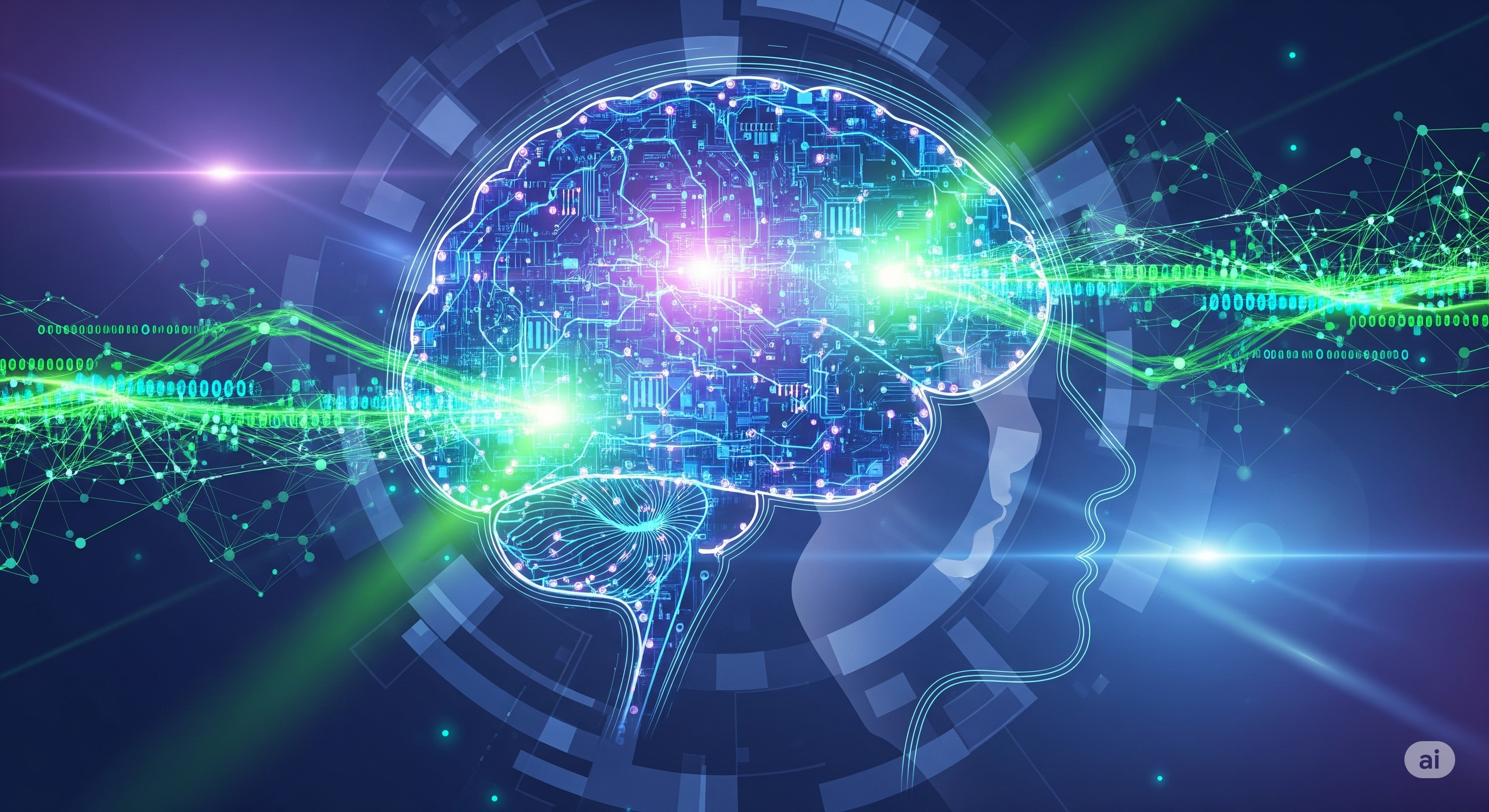
The AI Awakening: Deep Learning's Leap to Senses and a Voice!
Remember those sci-fi blockbusters where Artificial Intelligence wasn’t just a fancy calculator but a sentient entity, capable of understanding human nuances, emotions, and complex situations through sight, sound, and natural conversation? For years, this vision remained firmly in the realm of fiction. But what if we told you that thanks to staggering advancements in Deep Learning, this future isn’t just knocking on our door – it’s walking right in, ready to chat?
Deep Learning, the engine powering much of today’s AI revolution, has undergone a monumental transformation. From its roots in pattern recognition and predictive analytics, it’s now enabling machines to perceive the world in ways that mimic human senses, understand context, and respond with an unprecedented level of intelligence. The latest breakthroughs are nothing short of breathtaking, pushing us into an era where AI can truly see, hear, and speak like never before. This isn't just an upgrade; it's an awakening.
Beyond Text: The Multimodal Revolution Unleashed
For a long time, AI capabilities were largely siloed. We had impressive Computer Vision models that could identify objects in images, powerful Natural Language Processing (NLP) systems that could generate human-like text, and sophisticated audio processing units. Each excelled in its domain, but their ability to truly integrate these senses – to understand how a gesture complements a spoken word, or how a scene informs a conversation – was limited.
This is where multimodal AI steps in, and it's the latest frontier where Deep Learning is making its most significant impact. Multimodal AI refers to systems that can process and understand information from multiple types of data simultaneously, such as text, images, audio, and video. It’s about building AI that doesn’t just see *an* object, but sees *you* looking at an object, understands your question about it, and replies with appropriate contextual awareness.
The Breakthrough Moment: Seeing, Hearing, and Responding in Real-time
Recent developments, particularly from leading AI research labs, have demonstrated systems capable of true real-time multimodal interaction. Imagine holding up a sketch of a design to your phone, and the AI not only identifies it but asks clarifying questions about its function, suggests improvements, and even helps you draft a detailed plan – all through natural, instantaneous conversation.
These new Deep Learning models can now engage in fluid, real-time voice conversations, comprehending not just the words spoken but also the tone, emotion, and pauses. Crucially, they can simultaneously interpret visual cues – your facial expressions, gestures, the objects in your environment – and weave this information into their understanding and responses. This isn't delayed processing; it's happening live, making interactions feel remarkably human-like.
The applications are profound:
* Live Translation: Imagine speaking to someone in a foreign language, and an AI instantly translates, preserving emotional nuance and even interpreting gestures for a truly seamless cross-cultural dialogue.
* Assistance for the Visually Impaired: An AI companion could "see" the world for someone, describing their surroundings, reading labels, and navigating complex environments in real-time.
* Personalized Tutoring: An AI could observe a student's problem-solving process, understand their verbal questions, and provide dynamic, visually-assisted guidance.
* Complex Problem Solving: From intricate engineering tasks to medical diagnostics, AI can now analyze visual data (scans, blueprints), listen to expert commentary, and contribute to solutions with unprecedented depth.
Deep Learning's Secret Sauce: Why Now?
This multimodal leap isn't a sudden magic trick. It's the culmination of years of iterative Deep Learning research, fueled by specific advancements:
Transformer Architectures Evolve
The Transformer architecture, initially popularized by its success in Natural Language Processing (think Google Translate), has proven incredibly versatile. Researchers have found ways to adapt and extend these architectures to handle multiple data types simultaneously, allowing them to learn relationships between text, images, and audio within a single, unified framework. This means the AI isn’t just combining separate interpretations; it’s learning a holistic understanding from the ground up.
Massive Data & Computational Power
The relentless scaling of available data and computational resources (especially GPUs) has been critical. Training models that can understand the intricate relationships between different modalities requires truly enormous datasets and immense processing power. The ability to leverage petabytes of mixed media data has been a game-changer.
Innovative Training Techniques
Beyond just bigger models and more data, novel training techniques have emerged. Self-supervised learning, for instance, allows models to learn from vast amounts of unlabeled data by predicting missing parts or relationships between different views of the same data (e.g., predicting an image caption from the image itself). This has enabled AI to develop a more robust and generalized understanding of how different senses intertwine.
The Impact: A Glimpse into Our AI-Powered Future
The implications of this multimodal AI awakening are staggering, promising to reshape nearly every facet of our lives.
Transforming Industries
* Healthcare: AI can assist doctors in diagnosing diseases by analyzing medical images, listening to patient symptoms, and cross-referencing vast databases.
* Education: Personalized AI tutors can adapt to a student's learning style, offering explanations visually, audibly, or textually, based on their real-time engagement.
* Customer Service: Imagine an AI that not only understands your spoken query but also sees the product you’re referring to, guiding you through troubleshooting steps with visual aids.
* Creativity: Artists, musicians, and writers can collaborate with AI that understands their creative vision and offers multimodal suggestions.
* Robotics: Robots can become more intuitive and context-aware, understanding human commands, gestures, and the environment simultaneously, leading to safer and more effective human-robot collaboration.
The Human-AI Frontier
This shift signifies a profound change from AI as merely a tool to AI as a collaborative agent. It opens doors to entirely new capabilities, allowing humans to offload complex cognitive tasks to AI partners that truly understand their intent and context. Productivity could skyrocket, and the boundary between human and machine capabilities could blur in exciting, unprecedented ways.
Addressing the Echoes: Challenges and Ethical Considerations
While the potential is exhilarating, it’s crucial to acknowledge the significant challenges and ethical considerations that accompany this rapid advancement.
The "hallucination" problem, where AI generates plausible but incorrect information, remains a concern, especially when integrating multiple modalities. Bias in training data can lead to skewed or unfair interpretations across different demographics, making robust dataset curation and bias mitigation techniques more vital than ever. Privacy implications are also paramount: an AI that can see and hear everything around us demands stringent safeguards and ethical guidelines for data collection, usage, and consent. Finally, the societal impact, including potential job displacement and the need for new skills, requires thoughtful discussion and proactive planning. Responsible AI development, focusing on safety, transparency, and alignment with human values, is not just an option—it’s an imperative.
The Dawn of Truly Perceptive AI
We are witnessing a pivotal moment in the history of Artificial Intelligence. Deep Learning is no longer just processing data; it’s beginning to perceive, understand, and interact with our world through a tapestry of senses, mirroring our own human experience. The journey from coded logic to perceptive intelligence is accelerating, and the implications are both thrilling and profound. The future where AI serves as an intuitive, multimodal partner is no longer a distant dream, but a rapidly unfolding reality.
What do you think about AI gaining senses? How do you envision these powerful new capabilities changing your daily life or industry? Share your thoughts and predictions in the comments below – let’s explore this exciting future together!
