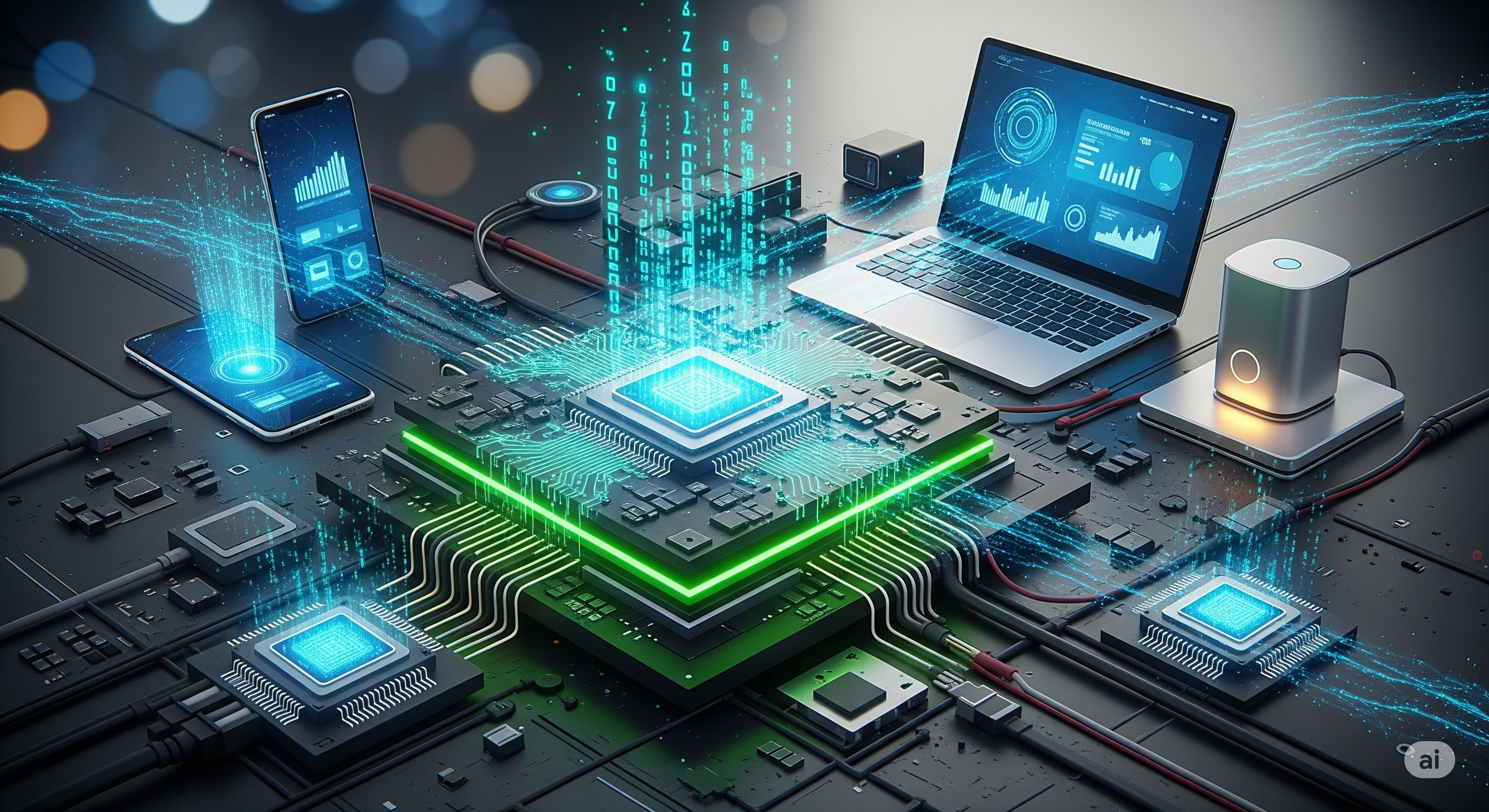
The Brains Behind the Things: How AI is Supercharging the IoT Revolution
Remember when "smart" simply meant connected? Your thermostat adjusted itself, your doorbell showed you who was at the door, and your watch tracked your steps. These were the early whispers of the Internet of Things (IoT) – a network of physical devices embedded with sensors, software, and other technologies, enabling them to connect and exchange data over the internet. It was revolutionary, transforming how we interact with our environments and data.
But a new chapter is rapidly unfolding, far more profound than just connectivity. What happens when these "things" don't just collect data, but *understand* it? What if they could predict, learn, and even make decisions autonomously? This isn't science fiction; it's the AIoT revolution, where Artificial Intelligence is becoming the "brains" behind the "things," catapulting us into an era of truly intelligent environments. This isn't just the latest tech buzz; it's the fundamental shift that's redefining our homes, cities, industries, and even our healthcare. Get ready, because the future of connection isn't just smart – it's brilliant.
The Evolution: From Connected Devices to Intelligent Systems
For years, IoT devices excelled at data collection. Sensors measured temperature, cameras captured images, and wearables tracked biometrics. The sheer volume of this data was staggering, but often, its true potential remained untapped without deep analysis. This is where AI steps in.
AIoT merges the power of IoT's ubiquitous data collection with AI's analytical prowess. Instead of merely reporting that a machine's temperature is rising, an AI-powered industrial IoT (IIoT) sensor can *predict* a potential breakdown hours or days in advance, based on historical patterns and real-time anomalies. In a smart home, instead of simply adjusting lights, an AI-enabled system can *learn* your daily routines, anticipate your needs, and proactively optimize settings for comfort, security, and energy efficiency. This transformation from passive data reporters to proactive, intelligent assistants is the core of the AIoT revolution, making devices not just connected, but truly conscious and responsive.
Where AIoT is Making Waves
The impact of AIoT is far-reaching, permeating every aspect of our lives and economy. Here’s a glimpse into the sectors being reshaped:
Smart Homes: Beyond Convenience
The smart home market is perhaps the most visible frontier for AIoT. With recent advancements like the Matter standard, which promises seamless interoperability between devices from different brands, the stage is set for an unprecedented level of integration. But AI takes this beyond simple convenience. Imagine a home that understands your unique preferences: adjusting lighting not just based on the time of day, but on your mood or activity; optimizing heating and cooling based on predictive weather analysis and your specific comfort profile; or even enhancing security by distinguishing between a family member and an unfamiliar visitor, learning patterns of unusual activity. AI transforms a collection of smart gadgets into a truly intuitive living space that anticipates and responds to your individual needs, often before you even consciously recognize them.
Smart Cities: Building the Future, Intelligently
Our urban landscapes are rapidly becoming living, breathing data ecosystems, and AI is the architect of their intelligence. In smart cities, AIoT sensors are deployed across infrastructure to monitor traffic flow, manage waste collection, optimize public transportation, and even predict air quality patterns. AI algorithms analyze this massive influx of data to dynamically adjust traffic lights, dispatch waste management teams more efficiently, identify infrastructure faults before they become critical, and enhance public safety through intelligent surveillance systems. The result is a city that runs more smoothly, sustainably, and responsively to the needs of its citizens.
Industrial IoT (IIoT): The Brains of Business
In industrial settings, AIoT is revolutionizing operations. Factories are becoming "smart factories" where machines are not just connected but are constantly learning and self-optimizing. Predictive maintenance, powered by AI, can analyze vibrations, temperatures, and other operational data from machinery to forecast potential failures, allowing for repairs *before* costly downtime occurs. AI also enhances quality control by instantly identifying defects, optimizes supply chains by predicting demand fluctuations, and improves worker safety through intelligent monitoring systems. The ROI for AIoT in manufacturing, logistics, and energy is immense, driving unprecedented levels of efficiency, productivity, and cost savings.
Healthcare (IoMT): A New Era of Care
The Internet of Medical Things (IoMT) is perhaps where AIoT promises the most profound human impact. Wearable devices, smart sensors, and connected medical equipment are collecting vital health data in real-time. AI analyzes this data to provide personalized health insights, detect early signs of chronic conditions, and even predict health crises. Remote patient monitoring allows healthcare providers to keep a close eye on patients from afar, enabling timely interventions and improving outcomes. AI also assists in drug discovery, personalized treatment plans, and operational efficiency within hospitals, making healthcare more accessible, proactive, and tailored to the individual.
Addressing the Elephants in the Room: Security and Privacy
As our world becomes more connected and intelligent, concerns about data security and privacy naturally escalate. The thought of AI-powered devices collecting vast amounts of personal and sensitive data can be unsettling. However, AI isn't just a potential vulnerability; it's also a powerful tool for enhancing security.
AI algorithms can detect anomalous behavior in network traffic, identifying potential cyber threats far faster and more accurately than traditional methods. Edge AI, where data processing happens closer to the source (on the device itself rather than in the cloud), can significantly reduce the amount of sensitive data transmitted, boosting both privacy and speed. Furthermore, robust data anonymization techniques and stringent regulatory frameworks are evolving in parallel with AIoT development to ensure responsible data handling. The industry recognizes these challenges, and a concerted effort is being made to embed security and privacy by design into every layer of AIoT systems.
The Road Ahead: What's Next for AIoT?
The AIoT revolution is still in its nascent stages, with exciting developments on the horizon:
* Edge AI Dominance: Expect more AI processing to happen at the "edge" – directly on devices. This reduces latency, saves bandwidth, and significantly enhances privacy and security.
* Digital Twins for Everything: AI will enable the creation of sophisticated digital twins – virtual replicas of physical assets, processes, or even entire cities. These twins will be used for real-time monitoring, simulation, and predictive analysis, optimizing everything from factory floors to urban planning.
* Sustainable IoT: AI will play a critical role in making IoT systems themselves more sustainable, optimizing their energy consumption, predicting maintenance needs, and managing resource usage across vast networks.
* Hyper-Personalization and Autonomy: As AI models become more sophisticated, IoT devices will offer hyper-personalized experiences, anticipating needs with uncanny accuracy, leading to truly autonomous systems that manage complex environments with minimal human intervention.
Join the Intelligent Future
The convergence of AI and IoT is not merely an upgrade; it's a paradigm shift. It’s moving us from a world of connected devices to one of intelligent environments, where our homes, cities, and industries don't just respond to our commands but understand our needs and anticipate our actions. This intelligent future promises unprecedented efficiency, comfort, and safety, fundamentally altering how we live, work, and interact with the world around us.
What are your thoughts on an AI-powered world? How do you envision AIoT impacting your daily life or industry in the next five years? Share your predictions and insights in the comments below, and don't forget to share this article with your network – let's spark a conversation about the intelligent revolution!
